What sets Winjoin apart when every bolted joint has to hold.
In oil, gas and process facilities, a fastener is easy to overlook—until corrosion, seizure or lost preload turns a small component into a leak, shutdown or safety risk. Winjoin’s proposition is to engineer the fastener, coating and load-retention system around the service.
A critical bolted joint does several jobs at once. It must carry load, preserve gasket compression, tolerate temperature and pressure cycles, resist the surrounding medium and still be maintainable years later. Winjoin stands out because its published range addresses these connected problems rather than treating the bolt as an isolated commodity.
Two decades focused on industrial fastening
Winjoin traces its establishment to 2005. Its published company profile describes a development path from industrial fastener supply into coated fasteners for acidic environments, higher manufacturing capacity and, in 2023, a new intelligent factory in Zhejiang. The company reports a 24,000-square-metre facility and annual capability of approximately 9,000 tonnes of fasteners together with three million disc springs.
Scale matters, but history is useful only when it produces repeatability. Winjoin’s stated model brings raw material control, forming and machining, heat treatment, coating, testing, warehousing and product delivery into a coordinated manufacturing system. For owners and EPC contractors, that can simplify technical responsibility and make documentation easier to trace across a bolting package.

Fastener selection should not end with diameter and grade. The operating temperature, pressure, medium, external atmosphere, tightening method, friction coefficient, inspection level and future maintenance strategy all belong in the same technical decision.
The attributes that distinguish the range
Oil and gas standards
The published scope covers API 20E and API 20F bolting, ASTM and ASME material families, BSL-1 and BSL-2 requirements and petrochemical flange-fastener standards.
Material breadth
Carbon and alloy steels sit alongside stainless, duplex and nickel-alloy options for temperature, strength and corrosion requirements.
YFluo coating systems
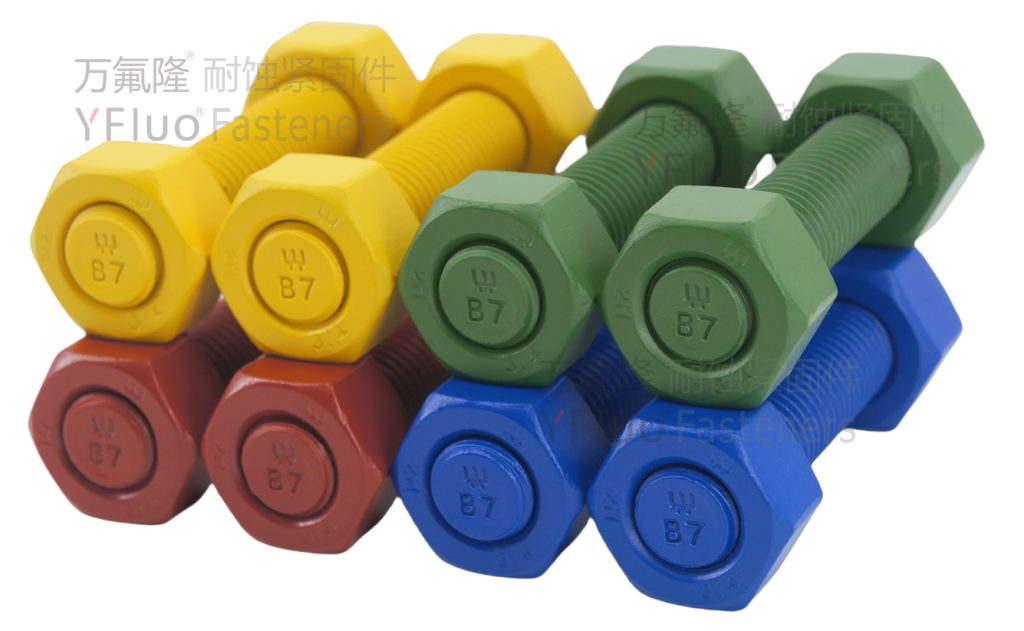
Fluoropolymer, zinc-nickel, cermet and acid-resistant systems provide different combinations of corrosion resistance, temperature capability and assembly behaviour.
High-temperature protection
The 501GS aluminium-ceramic family is published for service up to 600°C, addressing oxidation and seizure around heated equipment.
Preload retention
Disc springs compensate for relaxation caused by thermal movement, pressure change, vibration and creep, helping preserve sealing load.
Quality infrastructure
Winjoin publishes ISO 9001, ISO 14001, ISO 45001, PED, API and NORSOK-related qualifications, subject to project-by-project certificate verification.
A product range built around failure modes
| Operating challenge | Relevant Winjoin capability | Potential benefit |
|---|---|---|
| External corrosion and difficult disassembly | YFluo 801 and 802 coated fasteners | Longer maintenance intervals, reduced seizure risk and easier planned removal when correctly specified. |
| High-temperature oxidation | 501GS aluminium-ceramic coating | Protection for bolting around hot equipment and piping within the verified service envelope. |
| Acidic chemical exposure | ResAcid / application-specific coating systems | A coating route designed around aggressive chemical media rather than general atmospheric corrosion alone. |
| Pressure or thermal cycling | Pre-load disc springs | Compensation for joint relaxation to support gasket compression and reduce leakage risk. |
| Critical upstream equipment | API 20E / 20F fasteners | Structured bolting requirements for oil and gas service, with the appropriate BSL and documentation level. |
| Severe material duty | Nickel alloys, duplex stainless and special grades | Material selection aligned with strength, temperature and corrosion requirements. |
A published customer history across major industries
Winjoin’s English company profile reports early qualification or supply relationships involving ConocoPhillips and BP in 2005; Celanese in 2006; and Dow Chemical, Bluewater, SBM, FMC, Schlumberger, Devon and Shell in 2007. It also cites approval by National Oilwell Varco in China in 2008, later qualification or project activity involving Honeywell, Sinochem, INVISTA, Wanhua Chemical and BASF’s Zhanjiang project.
These names indicate the type of technical environments Winjoin says it has served, but they should not be read as current endorsements. For any Kuwait tender or operator qualification, Deema Trading would request project-specific references, current approvals, certificates, inspection plans and traceable documentation directly from the manufacturer.
Where the strongest Kuwait fit may be
- Refineries and petrochemical plants: flange bolting, pressure equipment, hot service, shutdown replacement and corrosion-prone outdoor installations.
- Upstream oil and gas: API bolting, manifolds, well-service equipment, flowlines and facilities exposed to heat, salinity and aggressive environments.
- Marine terminals and offshore assets: corrosion-resistant fasteners for splash-zone, coastal and high-humidity conditions.
- Power and water facilities: bolted joints exposed to thermal cycling, treatment chemicals, salinity and continuous outdoor service.
- EPC and maintenance contractors: engineered bolting packages with material, coating, testing and documentation coordinated around the project specification.
The best product is the one matched to the joint
Winjoin’s range is broad enough to invite a common mistake: choosing the most impressive coating or alloy rather than the right system. A coating changes friction and therefore influences tightening. A high-temperature product may not be the correct answer for chemical immersion. A disc spring must be calculated around the joint load and movement. API or NORSOK references must be tied to the exact manufacturing route and certificate required by the client.
The practical advantage is not one universal product. It is the ability to compare materials, coatings and preload-control options within a single technical conversation—and then document why the selected combination fits the service.
Sources and verification note
This article uses Winjoin’s published website and its English ADIPEC exhibitor brochure. Company history, capacity, certifications and customer references are manufacturer-reported and should be verified for each prequalification, tender and purchase order.
Winjoin — official website ↗Winjoin — English company and product capability brochure ↗CIPPE exhibitor profile — Winjoin industrial fasteners ↗